

No products in the cart.
Loading...
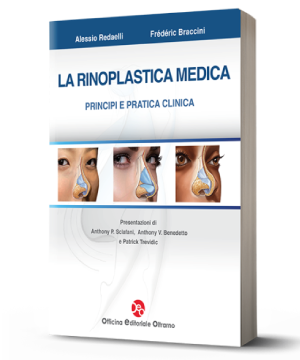
Medical Rhinoplasty – Principles and Clinical Practice (2nd Edition)
This aesthetic medicine textbook is essential for all aesthetic physicians who wish to delve deeper into the main methods of using absorbable fillers and botulinum toxin for medical rhinoplasty.
Cost: 120 €
In stock
Loading...
The nose! But what importance does this organ have on and in the face? Have we ever stopped to think about it? Smell is a sense of fundamental importance throughout our lives, from birth, when it allows young of all species to immediately recognize their mother, until death. And its enormous importance in facial aesthetics, so central and intertwined with all the other structures of the face, is clear to everyone, patients and doctors alike. But how can we define the nose as “beautiful and ideal”?
While it’s perhaps not possible to reduce the aesthetics of the nose, especially to certain, fixed standards, as it often depends on nuanced and varied details (some noses are often “interesting” in their imperfection), there is certainly a universally accepted concept of “harmony” that ultimately allows us to propose corrections to our patients based on a scientific and fairly well-established basis. The “rationale” in medicine, and even more so in surgery and aesthetic medicine, must always be evident and clear.
Only a clear rationale can lead to shared decisions between doctor and patient. For these reasons, all nasal corrections are among the most requested procedures by patients from aesthetic plastic surgeons, and the correction of nasal imperfections has been an eminently surgical field of medicine for many years.
There is also no doubt that in recent years there has been a huge increase in the correction of other facial imperfections that patients seek through aesthetic medicine, once the prerogative of surgery. These include, for example, facial wrinkles, which remain among the most frequently requested today. Indeed, facial wrinkles contribute significantly and actively to the overall appearance of the face, whether it is aged or not, to the expression of personality, and are particularly evident in the passage of time, as well as in certain aspects of people’s lives.
Aging of the nose, on the other hand, does not result in the appearance of wrinkles that fade into the background when we examine the face, and especially the nose, statically: their contribution to the aesthetics of the nose is evident only in cases of hyperactivity of some muscle groups related to facial expression. The nose ages mainly because certain small details change over time: the tip tends to droop, the skin and subcutaneous tissue, already extremely thin in this area of the body, especially on the bridge of the nose, become even thinner, the nasolabial angle narrows while the distance between the nasal spine and the upper lip increases.
These details make a nose look even older. As we often say in our courses, a person’s true age can be seen in their hands, their neck…and their nose! Traditional treatments for nasal deformities, as we’ve already mentioned, almost always involve surgery, and while some issues can be improved with minimally invasive surgery, surgical rhinoplasty remains a traumatic procedure, susceptible to numerous serious side effects.
This massive increase in minimally invasive and medical treatments, and the advent of completely safe, harmless, and long-lasting materials, especially on the nose, as we’ll see, led us, a few years ago, to propose and publish our experience in correcting certain nasal profile defects with a completely medical method—even less than “minimally invasive”—easy to perform if thoroughly mastered, extremely fast, and with sometimes astonishing results!
Some situations or procedures that would otherwise be strictly surgical can now be avoided. Even in these situations, where surgery would be indicated but the patient refuses, when there are high surgical risks, and in many other situations, medical treatment seems justified, and the concept of aesthetic medicine, combining injections of botulinum toxin and other usually absorbable materials, finds its full application.
| Weight | 0.977 kg |
|---|---|
| Dimensions | 23 × 28.8 × 1.5 cm |
Be the first to review “Medical Rhinoplasty – Principles and Clinical Practice (2nd Edition)”Cancel reply
Reviews
There are no reviews yet.